RepoIQ.
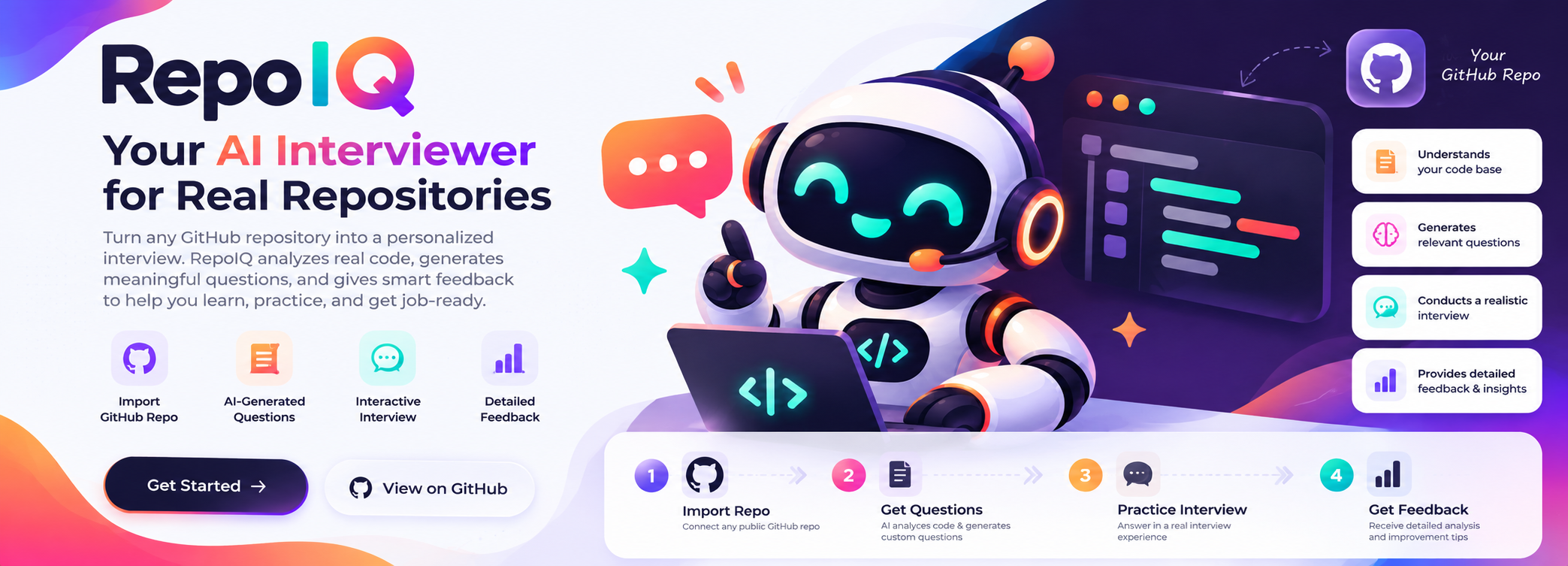
An AI-powered, repository-aware technical interview platform designed to analyze GitHub codebases and generate personalized technical interviews. Currently under development.
See the experience.
One product. Every screen.


Behind the build.
The Problem
Developers often build complex projects but struggle to explain their architecture, implementation choices, and underlying engineering concepts during technical interviews. Generic interview preparation rarely reflects the actual code developers have written. RepoIQ aims to bridge this gap through repository-aware technical assessments.
The Approach
I am designing and developing the platform architecture, GitHub integration, repository ingestion workflows, source-code filtering, backend APIs, and PostgreSQL persistence. AI-powered retrieval, question generation, and interview evaluation are planned development stages.
Decisions that matter.
GitHub integration enables repository discovery, metadata retrieval, source-code exploration, and filtering of irrelevant files before further processing.
FastAPI provides a modular Python backend, while Next.js and TypeScript are selected for the frontend. The architecture separates repository ingestion, code processing, and future AI interview services.
PostgreSQL with Neon provides persistent relational storage for repository and ingestion data. Multi-language code chunking supports structured source-code processing.
The planned RAG pipeline will retrieve relevant repository context for AI-generated technical questions. Text-based interviews, answer evaluation, and a voice interviewer are planned for later stages.
Built with purpose.
Project Record
The current development foundation includes GitHub repository integration, metadata retrieval, smart file filtering, PostgreSQL-backed ingestion, and multi-language code chunking. RAG-powered code understanding and personalized technical interviews are upcoming features.
RepoIQ is actively under development and has not been publicly launched. AI interview generation, answer evaluation, voice interaction, and production-scale testing are not yet complete.
GitHub Repository